
MENA Startups
Saudi FinTech Giant PayTabs Strikes Massive $100M+ Deal to Acquire Amazon’s MENA Payments Business, Creating Platform Set to Process Over $40B Annually
Saudi-born fintech PayTabs has agreed to acquire Amazon Payment Services’ Middle East and North Africa payments operations in a deal valued at more than $100 million, creating a combined business expected to process over SAR 150 billion annually.


Saudi fintech PayTabs Group has agreed to acquire Amazon Payment Services’ Middle East and North Africa payments operations in a transaction valued at more than $100 million, according to people familiar with the agreement cited by CNN Economics.
The transaction, which the sources said has been approved by both parties, would significantly expand PayTabs’ footprint across the region and bring Amazon’s regional payments business into the Saudi-born company’s infrastructure.
Following the integration, the combined operation is expected to process more than SAR 150 billion ($40 billion) in transactions annually, giving PayTabs considerably greater scale in a MENA payments market that remains fragmented across countries, banking systems and regulatory frameworks.
The acquisition would also represent a significant consolidation move in the region’s fintech sector, bringing together payment processing, automated transaction switching and payouts within PayTabs’ broader infrastructure.
PayTabs Makes a Major Consolidation Move in MENA Payments
PayTabs has spent years building payment infrastructure across the region, including banking connectivity, regulatory licences and technology designed to help merchants accept and manage digital payments.
Acquiring Amazon Payment Services’ regional operations would substantially accelerate that strategy.
Rather than expanding solely through organic growth and individual market entries, PayTabs would absorb an established payments operation with existing merchant relationships and infrastructure across the Middle East and North Africa.
People familiar with the transaction said the deal is valued at more than $100 million, although an exact purchase price and detailed transaction structure have not been disclosed.
The combined platform is expected to provide end-to-end payment infrastructure spanning transaction processing, automated switching and payouts, potentially allowing businesses to manage more of their payment operations through a single provider.
For PayTabs, the strategic value therefore extends beyond simply adding transaction volume. The acquisition could strengthen its ability to serve merchants operating across multiple MENA markets, where payment methods, banking connections and regulatory requirements can differ considerably from one country to another.
Combined Business Expected to Process More Than SAR 150B Annually
Scale is one of the most significant elements of the transaction.
The combined operation is expected to process more than SAR 150 billion annually, equivalent to roughly $40 billion, if the acquisition is completed under the current agreement.
That transaction volume would give PayTabs a substantially larger position in the regional payments infrastructure market and could create efficiencies across processing, merchant onboarding, compliance and banking connectivity.
Continuity is expected to be a priority during the integration process, with the companies seeking to minimise disruption to existing operations.
The combined infrastructure is also expected to support faster merchant onboarding and stronger local regulatory compliance, an increasingly important capability as governments and central banks across the region develop more sophisticated frameworks for digital payments and fintech companies.
Integrating the businesses will nevertheless be a critical part of the transaction. Payments infrastructure is deeply connected to merchants, banks and financial institutions, making operational continuity particularly important during any transfer of ownership.
From Saudi Startup to Regional Payments Infrastructure Player
The deal would mark an important step in PayTabs’ evolution from a Saudi-founded fintech into a larger regional payments infrastructure company.
The company has built its business around connecting merchants with payment networks and financial institutions while expanding its regulatory presence across different markets. It has also invested in AI-driven payment technologies and infrastructure capable of managing multiple stages of the transaction process.
The Amazon Payment Services acquisition would bring those investments into a considerably larger operation.
It also comes as payment providers across MENA increasingly compete on infrastructure depth rather than simply providing online checkout services. Merchants operating regionally need payment companies capable of handling local banking relationships, different payment methods, settlement, payouts and country-specific compliance requirements.
Owning more of that infrastructure can improve both economics and control over the payment experience, particularly as transaction volumes increase.
$100M+ Deal Could Reshape MENA’s Payments Market
The acquisition arrives during continued growth in digital commerce and financial technology across the Middle East and North Africa.
While digital payment adoption has expanded, MENA remains a collection of distinct markets with different regulators, banks, currencies and consumer payment preferences. That fragmentation creates complexity but also makes regional infrastructure providers strategically valuable.
By combining Amazon Payment Services’ MENA operations with its existing network, PayTabs would gain additional scale while consolidating several payment functions within a single regional platform.
The transaction is particularly notable because it would see a Saudi-born fintech acquire the regional payments operations of one of the world’s largest technology companies, signalling how far some homegrown MENA financial technology companies have progressed from local startups into regional infrastructure players.
With a deal value exceeding $100 million and combined annual payment volumes projected above SAR 150 billion, the acquisition could become one of the more consequential fintech transactions in the region, strengthening PayTabs’ position as consolidation accelerates across MENA’s digital payments industry.


MENA Startups
Saudi-based AutoTech Startup Autobia Raises $12M Series A to Expand B2B Auto Parts Platform and Logistics Infrastructure
The Artal Capital-led round will support Autobia’s logistics expansion, dynamic pricing technology and embedded financing services across Saudi Arabia.

The funding will support the company’s expansion across Saudi Arabia, strengthen its supply chain and logistics infrastructure, and accelerate the development of its proprietary pricing and inventory financing solutions.
Founded in 2021 by Emad Daghriri and Ahmed Aloufi, Autobia is building a digital platform that connects automotive spare parts wholesalers and retailers with suppliers while integrating procurement, delivery and flexible payment options.
Autobia Secures $12M to Scale Its B2B Marketplace
The Series A follows Autobia’s $2.5 million seed round in 2023, led by Sadu Financial with participation from Wa’ed Ventures.
The latest investment will help the company expand its geographic coverage and improve the infrastructure supporting automotive parts distribution across the Kingdom.
Unlike conventional e-commerce marketplaces focused primarily on product listings and transactions, Autobia combines sourcing, inventory procurement, logistics and embedded financial services within a single platform.
The company aims to address operational challenges faced by spare parts retailers and wholesalers, including fragmented supplier networks, inventory availability, delivery coordination and working capital constraints.
Expanding Logistics and Embedded Financing
Autobia plans to allocate part of the new funding to strengthening its supply chain and logistics capabilities as it expands into additional Saudi markets.
The platform allows merchants to source spare parts from suppliers, manage orders and arrange deliveries through an integrated procurement process.
Embedded financing is another component of Autobia’s business model. The company provides flexible, scheduled installment options for inventory purchases, helping merchants spread procurement costs over time.
It also enables retailers to manage end-customer payments through licensed payment providers and buy-now-pay-later services.
Co-founder and Chief Operating Officer Ahmed Aloufi said expanding access to embedded financial services remains central to Autobia’s strategy, particularly in helping merchants manage working capital limitations and pursue growth with greater flexibility.
Investing in Dynamic Pricing Technology
Beyond geographic expansion, Autobia will invest in proprietary dynamic pricing technology and broaden its installment-based inventory purchasing solutions.
The pricing tools are intended to help the platform respond to changing market conditions and improve how merchants manage procurement decisions across a diverse range of automotive parts.
These investments form part of Autobia’s broader strategy to build an integrated technology infrastructure for the automotive aftermarket rather than operate solely as a transactional marketplace.
Co-founder and CEO Emad Daghriri said the company’s ambition extends beyond digitizing spare parts purchases to providing traditional businesses with the market intelligence, operational efficiency and tools needed to compete and grow.
Investors Target Saudi Automotive Aftermarket Opportunity
Artal Capital led the investment alongside AlJazira Capital and Wa’ed Ventures, backing Autobia’s approach to combining technology, logistics and financial services.
Wassim Makhoul, Head of Alternative Investments at Artal Capital, described the automotive aftermarket as a substantial market with unmet needs. He highlighted Autobia’s combination of technology, operational capabilities and embedded financing as central to its growth potential.
Artal Capital aims to support the founders’ ambition to establish Autobia as a core infrastructure provider for automotive aftermarket services in Saudi Arabia and the wider region.
The financing comes as Saudi Arabia continues developing its digital commerce, logistics and financial technology sectors under Vision 2030.
Autobia will now focus on expanding its domestic operations, strengthening distribution capabilities and developing financial and pricing tools to support automotive parts merchants.
MENA Startups
TiE Women MENA Names Five Regional Winners to Compete for MENA Title at GITEX Global 2026
Five women founders from Egypt, Saudi Arabia, the UAE and the wider MENA region will advance to the TiE Women MENA finals at GITEX Global 2026 in December.

TiE Dubai has named five regional winners of the seventh edition of its TiE Women MENA program, selecting women-led startups across Egypt, Saudi Arabia, the UAE, the wider Middle East and an Emirati-focused track.
Following virtual regional finals held from September 8 to 17, Naglaa Mohamed, Co-Founder of Egypt-based P-Vita; Lea Mehaweg, Co-Founder and CEO of Saudi Arabia-based Maison Safqa; and Anuscha Iqbal, Co-Founder and CEO of UAE-based Qanooni AI, won their respective country tracks. Rowan Alawi, CEO of Trase, took the Rest of MENA category, while Aisha Alyassi, Founder and Brand Director of SCULP, won the Emirati track.
The five founders will compete for the MENA title at the program’s finals during GITEX Global 2026 in December.
More Than 250 Women-Founded Businesses Apply
TiE Women MENA attracted more than 250 licensed, women-founded businesses this year, up from almost 200 applications in 2025. The cohort spanned sectors including AI and SaaS, AgriTech and FoodTech, HealthTech, sustainability and fashion.
Of the applicants, 228 founders were shortlisted and 46 advanced to the regional finals. Each track selected one winner and two runners-up based on criteria including product-market fit, go-to-market strategy, team strength, competitive advantage, financial objectives and operational and technical viability.
Finalists also worked with dedicated mentors to refine their pitches and prepare their businesses for the regional competition.
The 2026 cohort reflected a strong focus on AI, with founders applying the technology to legal services, construction, livestock health, prenatal care and community platforms. Sustainability-focused companies included ventures addressing agricultural waste, textile reuse and water conservation, while several startups developed products around women’s mobility, mental wellbeing and maternal health.
Winners Head to GITEX Global 2026
At Expand North Star during GITEX Global 2026, each regional winner will receive a dedicated pod to showcase their business and connect with investors and other ecosystem stakeholders.
The five founders will continue receiving one-to-one mentorship ahead of the December final, with support focused on their pitches, go-to-market strategies and investor materials.
Carlina Marani and Shameema Parveen, Co-Chairs of TiE Women MENA 2026, said this year’s candidates stood out for both the quality of their pitches and the range of industries represented. They highlighted businesses spanning AI-powered water conservation and fetal health to sustainability and Emirati food products.
Aisha Alyassi described winning the Emirati track as an important milestone for SCULP, saying the program had encouraged her to expand her ambitions, refine the company’s vision and connect with other women founders.
Addressing MENA’s Female Funding Gap
The program comes as women-founded startups continue to receive a small share of venture funding across the region. According to figures provided by TiE Dubai, female-founded startups secured just $2.5 million in the first half of 2026, representing 0.14% of the region’s $1.7 billion in venture funding.
TiE Dubai said its program aims to narrow that gap through mentorship, funding access, visibility and regional networking.
Over the past four years, TiE Women MENA has supported more than 1,000 women-led businesses, curated over 350 pitches and awarded AED 380,000 in equity-free prize money. Globally, TiE Women has received more than 11,000 applications across 62 countries and accelerated over 500 women-led startups.
The MENA program is run by TiE Dubai and powered by Nokia, alongside partners TECOM, Dubai Internet City and in5 Innovation Centers.
MENA Startups
UAE Launches Ai Everything Abu Dhabi 2026, Connecting 150 AI Startups With Global Investors
The two-day AI event will connect more than 150 startups with over 200 investors managing $100 billion in assets, while showcasing emerging enterprise AI technologies.

Ai Everything Abu Dhabi 2026 will bring more than 150 AI startups to the UAE capital on October 6 and 7, showcasing technologies spanning enterprise software, industrial safety, customer experience and sovereign AI.
Held at the ADNEC Centre, the event will bring together more than 400 global technology companies and startups. Its Ai StartX Everything showcase will connect founders with more than 200 investors from 30 countries representing $100 billion in assets under management.
Among the companies exhibiting are startups from Portugal, Singapore, Saudi Arabia, the UAE and the US, with products focused on moving AI deeper into enterprise operations.
Enterprise AI Moves Into Critical Workflows
Portuguese AI-native software assurance company VisionHammer will showcase technology designed to diagnose and resolve problems within enterprise software while retaining human oversight.
Its platform can identify the root cause of an incident, generate and test a fix, and submit a pull request for approval. In one production deployment, VisionHammer said it reduced average incident resolution time from around five hours to four minutes.
The company will present CodeScan, which analyses code security with every release, and Assessment, a system for mapping and diagnosing enterprise software environments. Co-founder and COO Tiago Silva said demand is increasingly centred on AI that can operate reliably in critical systems while maintaining human control and auditability.
Singapore-headquartered Ailytics, meanwhile, will demonstrate AilyssaX, a vision-language-model-powered platform that converts existing CCTV networks into real-time industrial safety and operational intelligence.
Ailytics said it has completed more than 400 deployments across over 15 countries, with customers including Changi Airport Group, DHL, Laing O’Rourke and Obayashi. Following its recent Series A round, the company is expanding into the Middle East.
Gulf Startups Showcase Arabic and Sovereign AI
Saudi-based Lucidya will showcase its AI Agent and provide an early look at Agentic Workflows designed to automate customer journeys across enterprise systems.
The company said its Agentic CX Platform supports 17 Arabic dialects with more than 92% accuracy and uses billions of data points to interpret customer and market signals. Lucidya is also ISO/IEC 42001 certified and compliant with PDPL, GDPR and SOC 2.
Dubai-registered MetisJean will launch Jean 1001, its sovereign operating system for enterprise AI. The platform runs within a customer’s own infrastructure, makes its reasoning traceable to source material and records actions on an immutable, audit-ready ledger.
MetisJean said Jean can reduce token consumption by up to 90% in some applications. Founder and CEO Alexander Haywood said the company intends to build sovereign enterprise AI in the Gulf before taking the technology to international markets.
US-based Newrunio will also introduce Personal Super-Intelligence (PAI) 1.2 globally for the first time. The screen-aware floating AI agent operates within a user’s existing digital environment, providing contextual suggestions and executing tasks without requiring users to continually switch between applications.
Connecting AI Founders With Global Capital
Beyond product demonstrations, Ai StartX Everything will connect startups with investors, sovereign funds, enterprise buyers and technology companies through its Investor Programme.
The programme includes the Supernova AI Global Pitch Competition, where five finalists will pitch to investors and industry leaders for equity-free prizes.
Organised by inD, with Abu Dhabi’s Department of Government Enablement as Host Partner and Mubadala company Solutions+ as Global Partner, Ai Everything Abu Dhabi will also feature ATRC, First Abu Dhabi Bank and Hub71 alongside global technology companies including AWS, Alibaba Cloud, Microsoft, Mistral AI and ASUS.
-

 MENA Startups7 days ago
US Agentic Coding Platform Replit Acquires Analytics Startup Atta to Add Interactive Data Visualizations to AI Chat
-
 News1 week ago
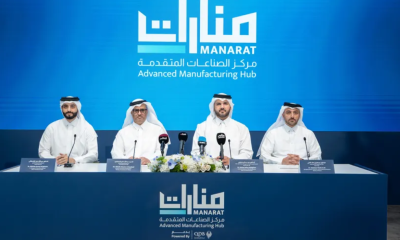
Qatar Development Bank Opens Applications for MANARAT, Offering Ready-Built Facilities to Help Manufacturers Adopt Industry 4.0 Technologies
-

 Asia Startups6 days ago
Indian HRTech Startup Scooter Raises $160K Pre-Seed Funding to Expand Sales Hiring Platform and Streamline Candidate Assessments
-

 Asia Startups6 days ago
Indian Startup SiMa.ai Raises $150M Series C to Scale Physical AI Platform and Develop Next-Generation Hardware
-

 Asia Startups6 days ago
Indian Experience-Tech Startup Alive App Raises $1M Seed Funding to Expand Experience Supply and Technology Capabilities
-

 MENA Startups5 days ago
UAE Launches Ai Everything Abu Dhabi 2026, Connecting 150 AI Startups With Global Investors
-

 MENA Startups5 days ago
TiE Women MENA Names Five Regional Winners to Compete for MENA Title at GITEX Global 2026
-

 Euro Startups6 days ago
Portugal-Based InsurTech Startup FRANK Raises €2.9M to Expand AI-Powered Platform for Automating Administrative Tasks Globally
You must be logged in to post a comment Login