
News
Qatar Development Bank Opens Applications for MANARAT, Offering Ready-Built Facilities to Help Manufacturers Adopt Industry 4.0 Technologies
Qatar Development Bank has launched Manarat, a new advanced manufacturing hub offering 16 ready-built factory units for technology-driven manufacturers, as Qatar seeks to accelerate Industry 4.0 adoption and develop factories capable of joining the World Economic Forum’s Global Lighthouse Network.

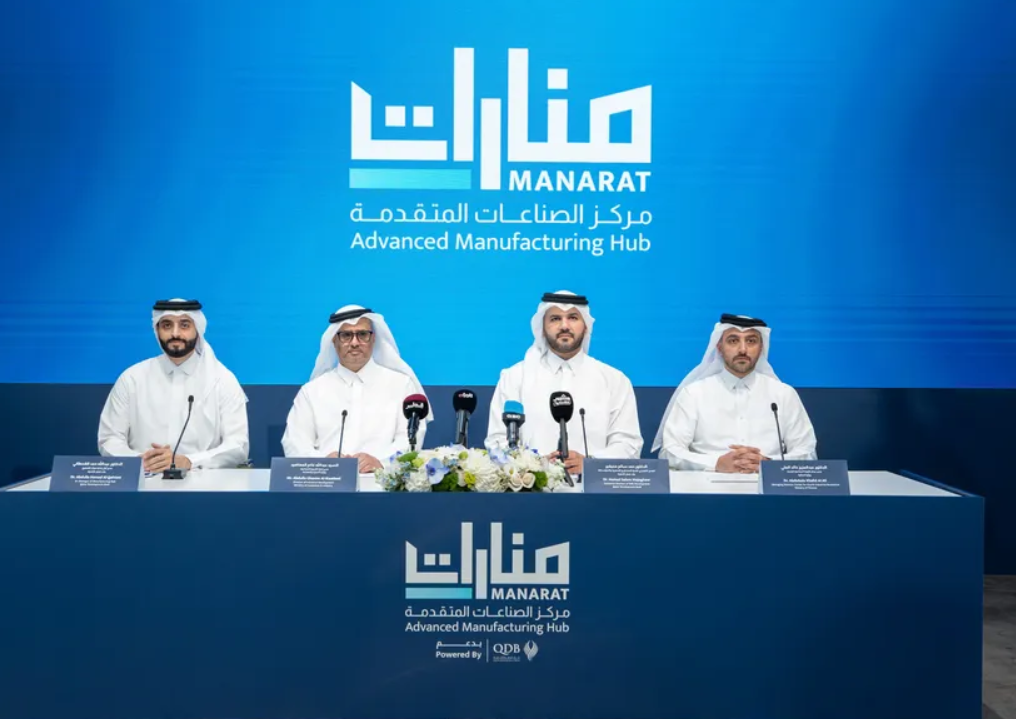
Qatar Development Bank (QDB) has launched the Advanced Manufacturing Hub (Manarat), a new industrial complex designed to accelerate the adoption of advanced manufacturing technologies and build a new generation of high-tech factories in Qatar.
Developed in partnership with the Centre for the Fourth Industrial Revolution (C4IR) at the Ministry of Finance and the Ministry of Commerce and Industry, Manarat is opening applications for 16 ready-built factory units located in Qatar’s New Industrial Area.
The initiative targets both Qatar-based manufacturers and international investors operating in technology-intensive industries, combining physical manufacturing infrastructure with advisory, financing and export support from QDB.
Manarat Targets Industry 4.0 Manufacturing
Manarat is designed around Fourth Industrial Revolution technologies, including automation, artificial intelligence and advanced digital systems that can improve factory productivity, efficiency and competitiveness.
The industrial complex will focus primarily on strategically important manufacturing sectors including medical devices, pharmaceuticals, electronics and telecommunications, robotics and chemicals, alongside other related industries.
Companies applying to Manarat will undergo a two-stage assessment. The first evaluates eligibility and technical readiness, while the second examines the technical and commercial viability of their proposed manufacturing projects.
The model is intended to bring technology-driven manufacturers, investors and expertise into a shared industrial ecosystem where companies can exchange knowledge while developing more sophisticated production capabilities.
Qatar Wants Factories to Join WEF’s Global Lighthouse Network
The name Manarat, meaning “Lighthouses,” reflects one of the initiative’s longer-term ambitions: helping factories operating from the hub develop toward the standards associated with the World Economic Forum’s Global Lighthouse Network.
The network recognizes manufacturing sites that have demonstrated advanced deployment of Fourth Industrial Revolution technologies and significant transformation of their operations.
Manarat is being developed through cooperation with the World Economic Forum’s Centre for the Fourth Industrial Revolution, with smart infrastructure and technology adoption forming central parts of the initiative.
Dr. Hamad Salem Mejegheer, QDB’s Executive Director of SME Development, said the hub is intended to help companies expand production capacity, attract international expertise and develop specialized knowledge locally.
“Investing in advanced manufacturing is a key pillar in strengthening Qatar’s position as a leading regional hub for industrial innovation and enabling our factories to join the WEF’s Global Lighthouse Network,” Mejegheer said.
QDB Combines Factory Space With Financing and Export Support
Manarat goes beyond providing industrial space. QDB plans to offer participating manufacturers an integrated support structure that includes advisory services, financing solutions and export support.
For international companies, the hub provides a potential route into Qatar’s manufacturing sector through ready-built facilities and access to a wider development ecosystem. For local manufacturers, it is intended to reduce barriers to adopting advanced technologies and expanding production.
Dr. Abdulaziz Khalid Al-Ali, Director of C4IR at the Ministry of Finance, said Manarat will provide infrastructure and standards aligned with international efforts to accelerate Industry 4.0 adoption.
The Ministry of Commerce and Industry is also seeking to increase the digital readiness of Qatari factories and encourage greater use of automation, AI and advanced digital solutions.
Qatar’s Industrial Investments Reach QAR 248.44 Billion
The initiative forms part of the Qatar National Manufacturing Strategy 2024–2030, which seeks to increase manufacturing’s contribution to non-hydrocarbon GDP, localize production and create specialized jobs in advanced technology.
Cumulative investment in Qatar’s industrial sector reached QAR 248.44 billion in the second quarter of 2026, according to figures cited by the Ministry of Commerce and Industry.
Manarat adds a dedicated advanced manufacturing component to those efforts, targeting industries where technology, specialized expertise and sophisticated production infrastructure can create higher-value economic activity.
By combining 16 ready-built factories with technology infrastructure and QDB’s financing, advisory and export capabilities, the initiative aims to help manufacturers move toward smarter production models while supporting Qatar’s broader push for economic diversification and a knowledge-based economy.


News
MoneyHash Partners With Geidea to Give Businesses Unified Access to Payment Infrastructure Across Saudi Arabia, UAE and Egypt
Payment orchestration platform MoneyHash has partnered with regional fintech Geidea, enabling businesses to access Geidea’s online payment gateway and supported payment methods across Saudi Arabia, the UAE and Egypt through a single MoneyHash integration.

Payment orchestration platform MoneyHash has partnered with regional payments company Geidea to expand the payment capabilities available to businesses across Saudi Arabia, the UAE and Egypt.
Through the partnership, companies already integrated with MoneyHash will be able to access Geidea’s online payment gateway and supported payment methods without building and maintaining a separate technical integration.
The collaboration adds Geidea to MoneyHash’s unified payment infrastructure, allowing merchants to manage its services alongside other payment providers and methods through the same orchestration layer.
One Integration for Multiple Payment Providers
MoneyHash is building infrastructure designed to reduce the technical complexity businesses face when operating multiple payment providers.
Traditionally, companies expanding into new markets often need to integrate separately with different gateways, acquirers and local payment methods. Each additional integration requires engineering resources to build, maintain and monitor, making payment infrastructure increasingly complex as businesses scale.
Payment orchestration platforms address that problem by creating a common infrastructure layer connecting businesses to multiple providers through a single integration.
Under the new partnership, businesses using MoneyHash can activate Geidea’s capabilities within that existing infrastructure rather than creating a separate connection.
“Businesses should be spending their time building great products, serving customers, and growing into new markets, not repeatedly rebuilding and maintaining payment infrastructure,” said Nader Abdelrazik, CEO and Co-founder of MoneyHash.
“Bringing its strong regional payment capabilities into the MoneyHash ecosystem gives businesses a simpler way to access the infrastructure they need while we take care of the complexity behind the scenes.”
Geidea Adds Regional Payment Capabilities
Founded in Saudi Arabia in 2008, Geidea has developed into a regional payments provider operating across Saudi Arabia, the UAE and Egypt.
The company has payment acquiring capabilities in Saudi Arabia and the UAE and payment aggregation capabilities in Egypt. Its broader offering includes online payment gateways, point-of-sale systems, payment terminals and business management tools.
Integrating those capabilities into MoneyHash gives merchants another route to accessing payment infrastructure across three major Middle Eastern and North African markets.
Pankaj Kundra, CEO of Geidea UAE, said the partnership is designed to give businesses greater flexibility in managing payments as they expand.
“Our collaboration with MoneyHash makes Geidea’s payment capabilities easier to access through a flexible, connected infrastructure,” Kundra said. “Together, we’re giving businesses greater choice and flexibility in how they manage payments and scale across the region.”
MoneyHash Targets Payment Complexity in Emerging Markets
MoneyHash provides a payment orchestration platform that allows businesses to integrate and operate multiple payment services through a single API.
Its infrastructure includes smart payment routing, multi-currency processing and a unified dashboard, allowing companies to manage different parts of their payment stack from one system.
That model is particularly relevant for companies operating across multiple markets, where payment preferences, providers and infrastructure can vary considerably between countries.
Instead of replacing individual payment providers, MoneyHash acts as the infrastructure connecting them, allowing businesses to add or change payment capabilities without rebuilding significant parts of their underlying payment systems.
Partnership Targets a More Flexible Regional Payments Stack
The collaboration comes as digital businesses across the region increasingly operate across borders, creating demand for payment infrastructure capable of adapting to different markets and customer preferences.
For MoneyHash, adding Geidea strengthens the range of regional payment capabilities accessible through its orchestration platform. For Geidea, the integration provides another distribution channel through which businesses can access its services.
The partnership was marked during Seamless Middle East in Dubai, where Abdelrazik and Kundra met ahead of the official announcement.
As both companies expand their presence in the region’s digital payments ecosystem, the integration is designed to give merchants greater flexibility to activate new payment services and enter additional markets without repeatedly rebuilding their payment infrastructure.
News
Qatar Leading Super-App Snoonu Launches Cross-Border Commerce Platform, Allowing Regional Brands to Enter Qatar Without Local Presence
Qatar-based super-app Snoonu has launched a cross-border commerce platform enabling regional retailers and brands to sell directly to consumers in Qatar without establishing a physical presence or separate local operation.

Qatar-based super-app Snoonu has launched Snoonu Cross-Border, a new commerce platform designed to give retailers, distributors and brands across the region a simpler route into the Qatari market.
The platform allows selected regional merchants to reach consumers in Qatar through Snoonu’s existing digital marketplace and delivery infrastructure, removing several of the operational barriers traditionally associated with entering a new market.
Through the service, consumers can discover and order products from regional brands directly through Snoonu, while participating merchants can access the company’s customer ecosystem and marketplace traffic without opening a physical store in Qatar.
Entering Qatar Without a Physical Store
Snoonu Cross-Border is aimed particularly at regional retailers, distributors and wholesalers seeking to test demand or expand their businesses into Qatar.
Under the model, merchants can operate using their existing business registration in their country of origin, without establishing a standalone customer and delivery operation or obtaining separate legal registration in Qatar.
Snoonu manages the customer journey within its ecosystem, from product discovery and ordering through to local delivery.
The model is intended to reduce the operational and legal complexity of cross-border expansion while providing brands with a local channel through which they can test and scale their presence.
“Regional commerce is increasingly about connecting markets, not simply opening physical stores,” said Hamad Mubarak Al-Hajri, Founder and CEO of Snoonu.
“With Cross-Border, we are creating a simpler path for brands across the region to reach customers in Qatar, while giving consumers access to more products and brands from across our region. This is another step in Snoonu’s journey to connect markets and build a more seamless digital commerce ecosystem.”
Regional Brands Already Joining the Platform
The platform is already onboarding brands across several high-demand categories, including electronics and gaming, sports nutrition, toys and games, and kitchen and home supplies.
Brands currently available through Snoonu Cross-Border include LMNT, ORS, SIS, Humantra, Ultima, Boya, Thorne, Sporter, Valeo and Devo.
By integrating these products into its existing marketplace, Snoonu is seeking to make cross-border shopping operate more like a local e-commerce experience for consumers in Qatar.
For merchants, the platform provides an alternative to committing significant resources to a new market before establishing demand, allowing businesses to access Qatar through Snoonu’s existing infrastructure.
Part of Snoonu’s Regional Growth Strategy
The launch forms part of Snoonu’s broader strategy to strengthen commerce links between businesses and consumers across the region.
Founded in 2019, Snoonu operates a Qatar-based super-app spanning e-commerce, on-demand services, q-commerce, last-mile logistics and B2B solutions.
With Cross-Border, the company is extending that infrastructure beyond domestic merchants by positioning its marketplace as a gateway for regional businesses seeking access to Qatar.
As the company pursues wider regional growth, Snoonu said the new platform is intended to make it easier for brands to test, enter and scale in the Qatari market, while expanding the range of products available to local consumers.
Regional businesses interested in joining the platform can register through Snoonu Cross-Border’s international sellers portal.
News
Elon Musk’s The Boring Company Raises $3 Billion at $23 Billion Valuation to Build 150km of Tunnels Across UAE
Elon Musk’s The Boring Company has raised $3 billion in a Series D round led by UAE-based entities, valuing the tunneling startup at $23 billion as it prepares to deploy more than 150 kilometers of underground transport infrastructure across the UAE.

Elon Musk’s tunneling startup The Boring Company has secured $3 billion in Series D funding, reaching a $23 billion valuation as it prepares for its largest international infrastructure expansion to date.
The round was led by UAE-based entities and included participation from Shamal Holding, Vy Capital, Human Capital, Valor Equity Partners, Sequoia Capital, Andreessen Horowitz (a16z), Temasek and Baron Capital, alongside other existing and new investors.
The new capital will support plans to deploy more than 150 kilometers of underground infrastructure across the UAE, building on the company’s existing collaboration in the country through the Dubai Loop project.
“Building upon significant existing success collaborating with the UAE on Dubai Loop, this strategic investment will accelerate the partnership to deploy mass quantities of underground infrastructure across the UAE,” The Boring Company said.
From Dubai Loop to a UAE-Wide Underground Network
The new investment significantly expands the scale of The Boring Company’s ambitions in the Emirates.
The company had already secured the Dubai Loop project, which is intended to introduce its tunnel-based transportation system to Dubai. The newly announced 150-kilometer deployment comes in addition to that previously awarded project.
The Boring Company’s Loop model uses underground tunnels to transport passengers, with the company pointing to its existing operation in Las Vegas as evidence that the technology has moved beyond its experimental stage.
According to Shamal Holding, the company’s Loop system has transported more than four million passengers in Las Vegas since 2021.
“The technology has moved beyond proof of concept,” Shamal Holding said, without disclosing the size of its investment in the latest round.
The UAE expansion would represent a major increase in the scale at which the technology is deployed internationally, extending underground infrastructure across the country rather than limiting operations to a single demonstration route.
$23 Billion Valuation
The Series D financing values The Boring Company at $23 billion, giving Musk’s infrastructure venture substantial new capital to pursue its growing project pipeline.
The round brings together several major global investment firms alongside UAE investors, reflecting investor appetite for the company’s underground mobility technology as it moves into larger commercial deployments.
The company has spent years developing systems intended to reduce congestion by moving transportation infrastructure underground.
Its most established commercial deployment remains the Vegas Loop, while the company has also expanded its pipeline into other markets.
In 2026, The Boring Company broke ground on another tunnel project in Nashville, Tennessee, alongside its expansion plans in Dubai and the wider UAE.
UAE Emerges as a Major Market for The Boring Company
The funding positions the UAE as one of the most important markets in The Boring Company’s next stage of growth.
Rather than deploying a limited pilot, the company plans more than 150 kilometers of tunnels, potentially creating one of the world’s largest deployments of its underground transportation infrastructure.
The expansion also comes as the UAE continues investing heavily in next-generation transportation, artificial intelligence and advanced infrastructure, while attracting global technology companies seeking large-scale environments in which to deploy emerging technologies.
For The Boring Company, the combination of fresh capital and a major UAE deployment could provide an opportunity to demonstrate whether its Loop technology can scale from individual projects into a much broader transportation network.
-

 Entrepreneurial Stories1 week ago
From an Early Arabic Social Network to 300 Million Game Downloads: How Hussam Hammo Built Tamatem Into a MENA Gaming Powerhouse
-

 MENA Startups1 week ago
Qatar’s GrowthX Invests $1M in AI Hiring Platform Hired Valley and Student Economy Startup Talebhub, Bringing Both Startups Into Snoonu Startup Factory
-
 MENA Startups6 days ago
Saudi-based FinTech erad Raises $22M Series A Led by MEVP to Accelerate SME Financing Across the GCC
-

 MENA Startups3 days ago
Qatar-Based AI Startup Aligator Raises $1.2M Seed Round to Expand Autonomous PR Agents Across MENA
-

 MENA Startups6 days ago
UAE-Based Consumer Company Amaani Raises $5M Series A to Expand AÏZA Across GCC Beauty Markets
-

 Euro Startups7 days ago
Chilean B2B Marketplace Lokal Raises $700K to Expand Retail Supply Platform Nationwide
-

 Asia Startups1 week ago
Singapore-Based Physical AI Startup TacnIQ.ai Secures $1.5M Pre-Seed Funding to Advance Tactile Models and Industrial Deployments
-

 Euro Startups4 days ago
Spain-Based AI Startup Reply Next Raises $455K Pre-Seed Funding to Scale Multi-Location Brand Management Platform
You must be logged in to post a comment Login